The moment you decide to take up a craft, a strange thing happens: suddenly there are too many to choose from. Knitting, pottery, watercolour, embroidery, candle-making, leatherwork, calligraphy, resin, macramé. Each one looks lovely in photos, each one has a passionate corner of the internet, and each one is quietly whispering that it should be the one. That's exactly why so many people stall before they even begin.
Choosing well isn't about picking the "best" craft. There's no such thing. It's about picking the craft that fits the life you actually have — your budget, your patience, your space, and the kind of satisfaction you're chasing. Get that match right and the hobby sticks. Get it wrong and you'll blame yourself for something that was really just a bad fit.
Be honest about your patience#
Different crafts reward different temperaments, and the biggest divide is speed. Some crafts give you a finished thing in an afternoon. Others ask for weeks of steady work before anything looks like the picture in your head. Neither is better, but choosing the wrong one for your personality is how beginners quit.
If you love a quick win and lose interest when things drag, lean toward fast-result crafts: pouring a candle, painting a small canvas, making a simple piece of jewellery, or stamping a card. You'll finish something the same day, and that hit of "I made this" is powerful fuel early on.
Ask yourself: would I rather hold something finished tonight, or slowly build one impressive thing over a month? Your answer rules out half the options instantly.
If, on the other hand, you find repetitive work soothing and you don't mind a long game, slower crafts like knitting a garment, cross-stitching a detailed pattern, or hand-quilting will suit you. These reward patience with something genuinely impressive, but only if you enjoy the journey rather than just the destination.
Be honest here rather than aspirational. Plenty of people choose a slow, intricate craft because they admire the results, then discover they hate the plodding process and quietly give up. It's far better to match the craft to how you actually spend a free evening than to how you wish you spent it. If you know you reach for quick, satisfying tasks, honour that; there's no prize for choosing the harder hobby.
Count the true cost before you commit#
Every craft has a headline cost and a hidden one. The headline cost is the starter supplies. The hidden cost is everything you'll keep buying to keep going. It's worth glancing at both before you choose, because an affordable-looking hobby can turn expensive fast.
Some crafts are famously cheap to run. Hand embroidery, basic drawing, paper crafts, and crochet need very little once you're set up, and the materials last a long time. Others carry ongoing costs or need equipment: pottery often means kiln access or studio fees, resin needs safety gear and moulds, and machine sewing needs, well, a machine.
- Low startup, low ongoing: drawing, embroidery, crochet, paper craft.
- Low startup, higher ongoing: painting (paint runs out), candle-making (wax and fragrance).
- Higher startup, low ongoing: hand-knitting once you own needles, wood whittling once you own a knife.
- Higher startup, higher ongoing: pottery, machine sewing, resin, leatherwork.
You don't need to pick the cheapest craft. You just want to walk in with your eyes open, so the running cost doesn't surprise you two months in. If money is tight right now, start with something in the low-low corner and move on once you know you love making things.
Look honestly at your space and mess tolerance#
A craft has to live somewhere in your home, and some are far tidier neighbours than others. This matters more than beginners expect, because a craft that's a hassle to set up and clean away simply won't get done.
If you're working at a kitchen table you have to clear for dinner, or in a flat with no spare room, choose a craft that packs into a box. Knitting, embroidery, drawing, and jewellery-making are all beautifully portable and leave almost no trace. You can pull them out for twenty minutes and tidy up in one.
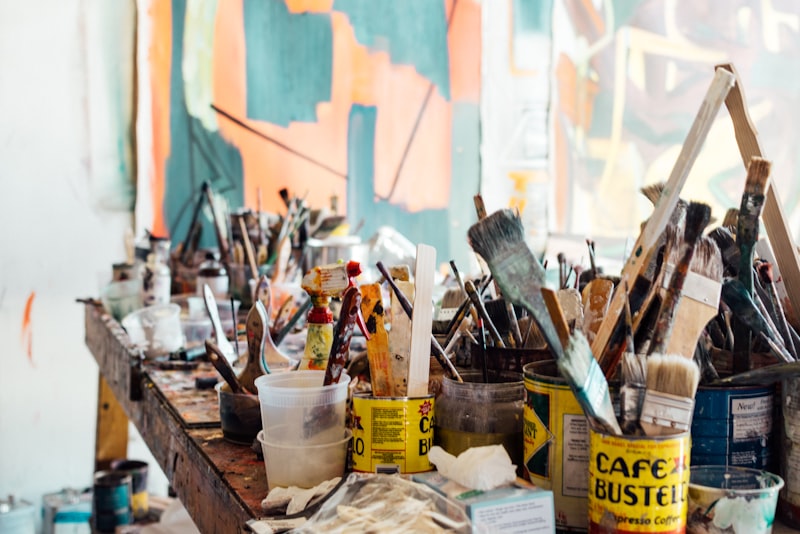
If you have a dedicated corner, a garage, or an outdoor spot and you don't mind mess, the messier crafts open up: pottery with its clay dust, painting with its rinse water, resin with its fumes, or woodwork with its shavings. These are wonderful, but they need somewhere they can be a little chaotic without stressing you out. A craft you dread cleaning up after is a craft you'll do twice and abandon.
Follow genuine curiosity, then test cheaply#
Once you've filtered by patience, cost, and space, you'll usually have two or three crafts left standing. This is where you get to be less practical and more honest with yourself. Which one have you quietly admired for a while? Which one, when you see it online, makes you think "I want to make that"?
That flicker of genuine curiosity matters, because it's what will carry you through the clumsy early weeks. A sensible choice you feel nothing about is easy to drop. A slightly less sensible choice you're excited about will get you back to the table again and again. If sticking with a new craft is something you've struggled with before, choosing one you actually care about is half the battle solved before you start.
Whatever you land on, test it as cheaply as possible. Borrow supplies from a friend, take a single beginner class, or buy the smallest possible starter set. Treat the first go as a trial run, not a commitment. If it clicks, wonderful — you've found your craft. If it doesn't, you've lost almost nothing and learned something real about yourself, which is worth the price of one small kit.
Just pick one and begin#
At some point, analysis has to give way to action. You could spend months comparing crafts and never make a single thing, which is the one outcome guaranteed to make you unhappy. The truth is that most beginner-friendly crafts are more alike than different in the early days: you'll be learning to be patient with your hands, to follow a tutorial, and to accept imperfect results, no matter which one you choose.
So make the call. Pick the craft that fits your patience, your wallet, and your space, and that gives you a little spark of "I want to try that." Then go and start your craft hobby from scratch with one small project and a tiny pile of supplies. You can always switch later — plenty of happy crafters tried two or three before one truly stuck. The only choice that leads nowhere is not choosing at all, so pick one today and let yourself find out.